Showing posts with label Strength of material. Show all posts

Saturday, July 25, 2020

CORE OR KERNEL

What is CORE OR KERNEL? CLICK HERE

        It is the portion of a cross section of a structural member in which nature of stess is same as applied load on the cross section i.e. if applied load is tensile then stress will also be tensile and if it is compressive then stress on the core is also compressive.

Calculation of  CORE OR KERNEL: CLICK HERE

  A) For circular cross-section

                   CORE OR KERNEL of a circular cross-section is also circular concentric to the main cross-section.To calculate the area of the core first we have have to calculate the radius of core and it will be maximum eccentricity.  CLICK HERE

maximum eccentricity, e = Z/A = d/8

where, d is diameter of the cross-section

Therefore, the area of core = π e ^2 = π d^2/64
Since here e is equal to d/8 therefore e is also called 1/4 th half of the cross-section.   
types of kernel,civil engineering subjects 

  B) For rectangular cross-section

                CORE OR KERNEL of a rectangular cross-section is of rhombus shape.Since here Z for both xx and yy axis have different value therefore there will two different e value also.

For x-axis , e(x) = Z(xx)/A = b/6

For y-axis , e(y) = Z(yy)/A = d/6

Thus side of the rhombus , e = sqr root [ e(xx)^2 + e(yy)^2 ]
                                       = 1/3 * [√(b/2)²+(d/2)²]
Therefore, e is called 1/3 rd half of the cross-section.
civil engineering subjects,civil engineering jobs

Friday, July 24, 2020

SECTION MODULUS

WHAT IS SECTION MODULUS?

          It is a resisting property of cross section of a structural member because of which the member tries to resist the force which causes bending in the member.   CLICK HERE
          Therefore the safety of the member against bending depends on this parameter and it is directly proportional. That means if section modulus Z increase safety of the member also increase with respect to the members having same cross sectional area but different Z. Therefore we can arrange the following cross sections according to their safety in basis of Z value as :

Stepped section > I section > Rectangular section > Square section > Circular section


section modulus of beam formula,civil engineering subjects,civil engineering jobssection modulus of beam formula,civil engineering jobs

Calculation of SECTION MODULUS   

         We can calculate Z with the help of moment of inertia. We have to carefully take the axis of moment of inertia.To calculate Z we have to take the moment of inertia I of that axis which will resist the bending . When in a cross section load is applied along a axis then it is resisted by the other axis perpendicular to it.Therefore,

Z = I(xx)/y or I(yy)/x according to the applied load      CLICK HERE

Calculation of MOMENT OF INERTIA 

          For calculation of moment of inertia we can directly use the formulas for different cross section as mentioned in the following table :   CLICK HERE


POLAR SECTION MODULUS

          In calculation of Torsional stress we have to consider resistance given by whole cross section since torsion try to rotate the whole cross section and since it varies radially.In this case we have to use a new type of section modulus called POLAR SECTION MODULUS.To calculate this Z we have to take moment of inertia which is summation of both the axis of cross section.Thus,

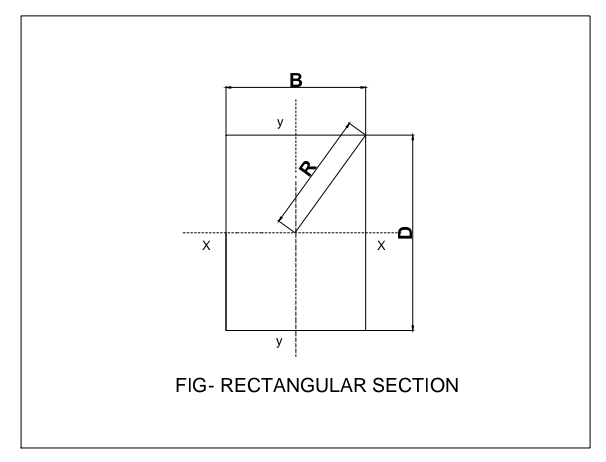
Z = I/R

where I = I(xx) + I(yy) and
R is the maximum radial distance of given cross section as in figure:

CLICK HERE FOR MORE

Thursday, July 23, 2020

LOAD AND EFFECT

WHAT IS LOAD?

        Forces acting on a body in its surface is generally called as LOAD. Body forces like gravity,inertia etc. are not included in LOAD.In this blog you will get LOAD AND EFFECT of those loads.

TYPES OF LOAD :CLICK HERE

        There are different types of loads based on in which point of the body the load actually applied.These can be classified as-
a) Normal load
b) Shear load
load vs stress,civil engineering subjects,civil engineering jobs

a) Normal load -(P1 and P2)

          Loads applied in the direction or parallel to the direction of longitudinal axis is called Normal load.This load can be further classified as-
i) Axial load 
ii) Eccentric axial load

b) Shear load -(Q1,Q2,R1 and R2)

          Loads applied in the direction or parallel to the direction of any of the transverse axis is called Shear load.This load can be further classified as-  
i) Transverse shear load
ii) Eccentric transverse shear load

EFFECTS OF DIFFERENT TYPES OF LOAD :CLICK HERE

i) Axial load -(P1)

          Axial load produces Axial stress in structural members acting along longitudinal axis i.e. in z-axis and uniform in every point of y-axis .Therefore we can conclude that axial LOAD AND EFFECT of aixal load is :
             
Axial stress, σ  = P/A (N/mm2)

where, P is the load and A is the area of cross section
civil engineering subjects,civil engineering jobs

ii) Eccentric axial load -(P2)

          As shown in fig-  the Eccentric axial load can be converted to axial load   and a couple  and hence it produces axial stress as earlier and bending stress which also acting in the direction of z-axis but in y-axis it is not uniform as shown in fig-  .Thus bending stress and axial stress both will act at yz - plane.

Bending stress, σ  = M/Z (N/mm2)

where M is constant i.e. M=P.e and
 Z is the section modulus and Z= I(xx)/y

CLICK HERE  for more about section modulus.
civil engineering subjects,civil engineering jobs

iii) Transverse shear load -(Q1 and R1)

         This type of loads produces Shear stress and Variable bending stress in structural member. Shear stress will act on xy - plane and varies along y-axis.Variable bending stress varies in z-direction also since here the bending moment M varies in z-direction according to bending moment diagram (BMD) which you will get in next blog..

The average shear stress is, Ï„ =P/A (N/mm2)

Again, Variable bending stress, σ  = M(z)/Z (N/mm2)

 where M(z) is the variable bending moment and 
Z is the section modulus and Z= I(xx)/y (for Q1 load)
                                               or
                                                      I(yy)/x (for R1 load)

CLICK HERE  for more about section modulus.

iv) Eccentric transverse shear load -(Q2 and R2)

         This type of load produces shear stress  and variable bending stress as earlier and in addition to this it also produces torsional shear stress.Again torsional shear stress will  varies in cross section but not in any particular axis.It will vary in radial direction.Therefore we can conclude that Eccentric transverse shear LOAD AND EFFECT of it is as follows:

Torsional shear stress, Ï„  = T/Z(p) (N/mm2)  

where T is the torsional moment and T=P.e and
Z(p) is the polar section modulus and Z(p)= I(xx)+I(yy)

CLICK HERE   for more about polar section modulus.
 In the above fig-05 torsion due to load Q2 is shown and the torsional moment is clockwise in nature.